
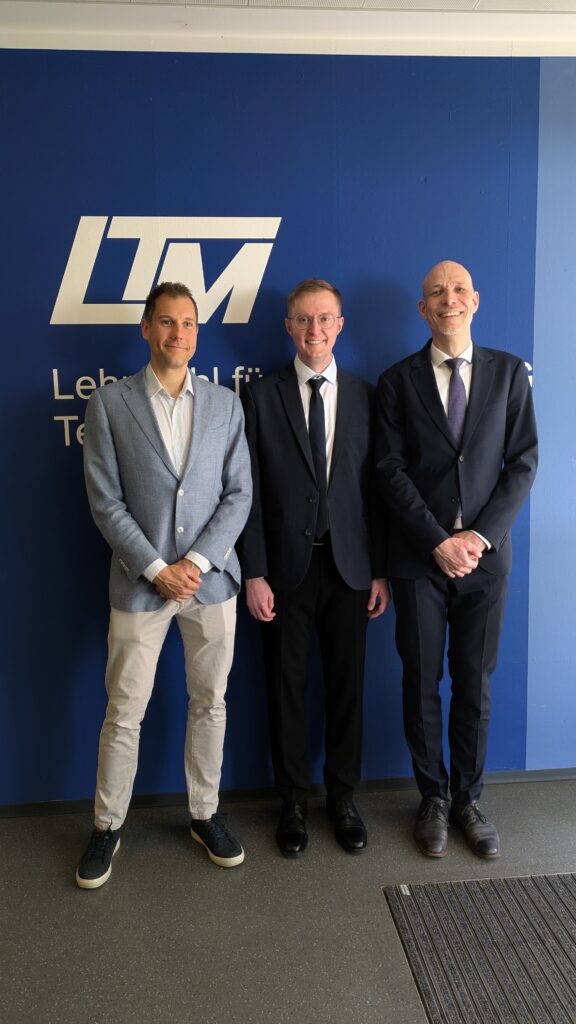
Felix Weber has successfully defended his doctoral thesis entitled “Multiscale fracture modeling of amorphous materials: Bridging atomistic and continuum mechanical perspectives”. After a public presentation and a public discussion, Felix had to undergo a non-public thesis examination. He did very well such that the final grade was with distinction. We congratulate Felix for this impressive result!
After joining the Capriccio group as a student, his first scientific work was his bachelor thesis on “Investigation of the Influence of simulation box size and polymer chain length on molecular dynamics simulations of polystyrene” in October 2019, followed by his project thesis on “A quantitative interphase model for polymer nanocomposites: Verification and validation in terms of size effects” in 2022 and his master thesis on “Systematic analysis and parameter optimization of the multiscale Capriccio method” in the same year. An outstanding activity was wihtout any doubt the preparation of the on-site renewal review of the research training group GRK 2423 “FRASCAL – Fracture across Scales”: There, he gave an exciting and impressive presentation on scale-bridging simulations of various materials for an important audience comprising the scientific reviewers, the responsibles of the German Science Foundation, the president of FAU as well as FRASCAL’s principal advisors and (post-)doctoral researchers. All these efforts were honoured by an extension of FRASCAL for another 4.5 years. Thanks a lot to Felix for his long-term committment to FRASCAL!
Felix has been involved in numerous scientific and social activities as, e.g., organising FRASCAL seminars and retreats as well as the Capriccio retreats, playing in the LTM band, and contributing to Capriccio junior parties.
His track record is outstanding: Felix has published seven peer-reviewed journal articles with three of them as first author in highly regarded scientific journals. Furthermore, he has six data publications complementing his journal articles.
We thank Felix for all his contributions in science and beyond. It was indeed a great pleasure to have him as a group member and we wish him all the best for his future career!